| Part 1 | |
|---|---|
| A1, A2 (8) | Join hands and two doubles left; two doubles right. |
| B1 (8) | Starting with the left foot, two singles forwards to the middle, and a double back again with the left. (4) Face your partner: set and turn single right. (4) |
| B2 (8) | Repeat B1. |
| Part 2 | |
| Repeat, lead in a double (with the left foot) and back (with the right) twice in the As. | |
| Part 3 | |
| Repeat, side right and left with your partner in the As. | |
| Part 4 | |
| Repeat, arm right and left with your partner in the As. | |
I had previously presented the following (see Addendum 26th June 2026):
| Part 1 | |
|---|---|
| A1, A2 (8) | Join hands and two doubles left; two doubles right. |
| B, C (12) | Starting with the left foot, two singles forwards to the middle, and a double back again. (4) Face your partner: set and turn single left, then set and turn single right. (8) |
| Part 2 | |
| Repeat, lead in a double and back twice in the As. | |
| Part 3 | |
| Repeat, side right and left with your partner in the As. | |
| Part 4 | |
| Repeat, arm right and left with your partner in the As. | |
T:Sellenger's Round or The beginning of the world
T:Suggested version from 3rd edition without final 4 bars (see Addendum 26th June 2026)
M:6/8
L:1/8
%%MIDI gchord f2cf2c
K:C
G | "G"G>AB GAB | "C"c3/2d/e/^f/ g>=fe | "F"=fga gaf | "G"e3 "C"c2 :|
|: c | "C"eg2 e2c | "G"Bd2 B>AG | Bcd e^fg | "D"^f3 d>e=f |
"C"e3/2d/c/d/ "G"B>AG | "C"c>de "G"d>cB | "D"ABG g^f3/2e//f// | "G"g3-g2 :|
T:Full version as written in 4th edition
M:6/8
L:1/8
K:C
G | "G"G>AB GAB | "C"c3/2d/e/^f/ g>=fe | "F"=fga gaf | "G"e3 "C"c2 :|
c | "C"eg2 e2c | "G"Bd2 B>AG | Bcd e^fg | "D"^f3 d>e=f |
"C"e3/2d/c/d/ "G"B>AG | "C"c>de "G"d>cB | "D"ABG g^f3/2e//f// | "G"g6 ||
"C"e>de "G"d>cB | "C"c3/2d/e/^f/ "G"g>=fe | "D"d>cB A>GA | "G"G6 ||

Sharp substituted the given tune for an older version of Sellingers Rownde found in the manuscript My Ladye Nevells Booke of virginal music by William Byrd, 1591. He states in the music published for the Country Dance Book that “*The above tune is not that given by Playford, but is the version used by Byrd, omitting his repetition of the last four bars.”
Sharp may well have done this because the tune in Playford is considerably harder to play. But it does give more lift to the dance, especially the singles found in the dance description. In fact this dance is very unusual in having singles not in the context of a set.
The tune in Playford 4th edition is in three parts, with a dotted bar line after the first part and a simple double bar line after the others. It’s also the only one I’ve spotted in 4th edition which has a double, non-dotted bar not at the end of the tune. In the other tunes in 4th edition, there’s a dotted double bar line between each part and a non-dotted double bar line at the end; in nearly all cases all the parts are repeated.
We shouldn’t read too much into this as it’s a fairly new innovation to have bar lines at all, and the convention that dots mean repeat has yet to be firmly established – they could simply be prettier double bar lines!
If you look at the transcription of My Ladye Nevells Booke, Sellingers Rownde is written consistent with only the first part being repeated, and including the extra “C” phrase that Sharp omitted.
The tune (without the dance) is also in the tune supplements to 3rd edition, apparently omitting the final part of the music, which might have been Sharp’s reasoning; I can’t find a (complete) digitisation.
The dance itself, after the introduction (which we’ll get back to) says:
Lead all in a D. forward and back · That again :
Two singles and a double back · Set and turn single · That again :
Lead in a double and back twice is clear. In the second part however, what does the “That again” relate to: just the set and turn single, or the singles in and a double back as well? Sharp changed the tune, effectively ignored the final part of music, made it repeat, and assumed that “That again” referred to the whole line. But why then the “ · ” after “Two singles and a double back”?
If we believe it’s only the set and turn single that is repeated, then it fits if the music is played AABC, which matches Byrd’s version too.
This still doesn’t fit the · and : marks though, because now you’ve got a · in the middle of the phrase! But if you look at the music, the last four bars of the B phrase and the four-bar C phrase are really just variations of each other. It’s not unreasonable that instead of considering this to be a tune with a 4-bar repeated A phrase, an 8-bar unrepeated B and a 4-bar unrepeated C, the dancing master who contributed this considered it to be a 4-bar repeated A phrase, a 4-bar unrepeated B phrase and a 4-bar repeated C phrase. It’s musically consistent, it just happens that the music provided has a variation for the repeat of the C phrase.
Which brings us to the introduction:
Take Hands and go round twice, Back again
All set and turn S. that again.
There are no symbols to mark time here. It’s unlikely that “go round twice” really meant twice round the circle – compare with Gathering Peascods, another round with a similar feel, which starts Go all 2. Doubles round, turn S.. “Go round twice” is I think more likely to mean two doubles round.
But how do we make this fit the music? It doesn’t say “Two singles and a double back”, as in the subsequent figures. You could argue that this phrase must therefore be left out, but the simpler option is simply to make this figure symmetric with the following ones, by inserting the “two singles and a double back” phrase in the gap. And it doesn’t make it a better dance to leave that out.
Addendum 26th June 2026
One downside of this interpretation is that your left foot isn't naturally free for the first of the set and turn singles. This isn't necessarily a problem – there are plenty of dances where you need to change feet, and it's easy to do so if bringing both feet together at the end of a phrase. It's common in Playford dances even to lead the second introduction (circle right / side right / arm right) with the right foot. But I taught this recently after teaching the full sequence of the measures of the Inns of Court, which are pretty strict about the sequence of feet, and it suddenly jarred.
A copy of 3rd edition is now online where this dance first appears; I thought that this was originally tune only but it does seem to have dance instructions too, appearing right at the end:
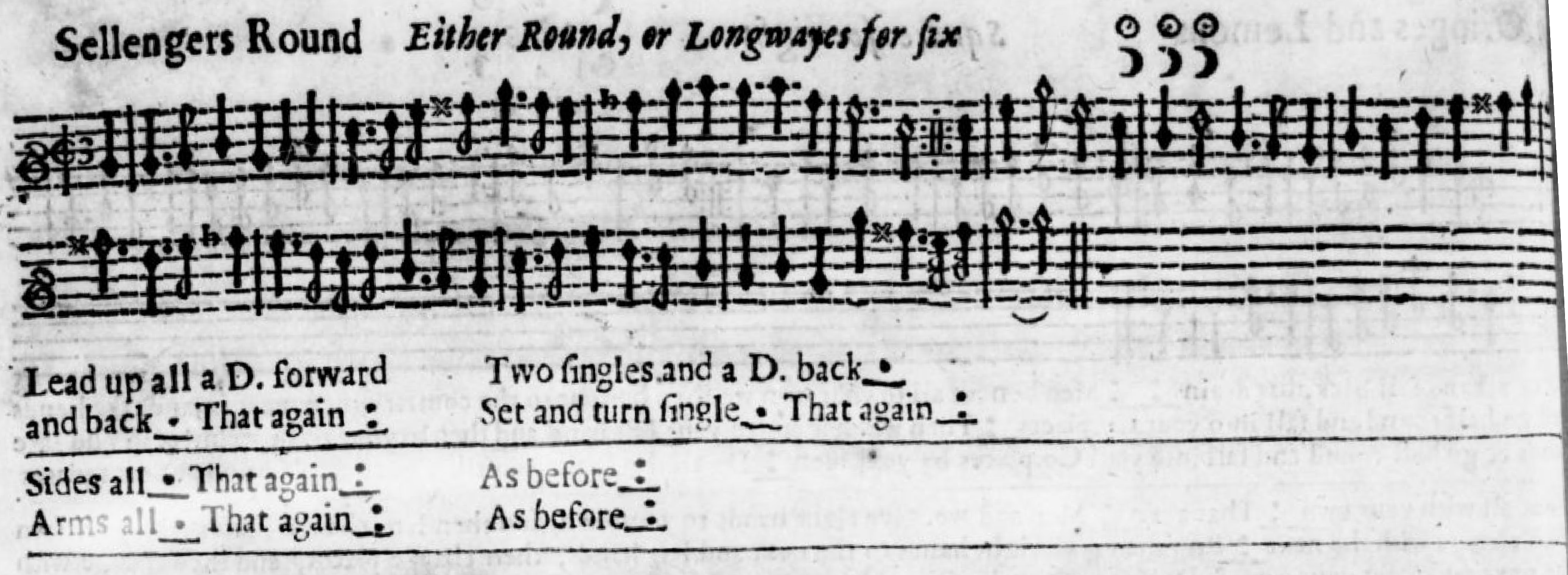
This is quite different and much simpler. The differences made from 3rd edition to 4th edition are:
Add an extra 4 bars of music
Add a 4th, shorter figure as an introduction
Change "Lead up all" to "Lead in all"
Change the dance formation from "Either Round, or Longwayes for six" to simply "Round for as many as will"
I don't believe John Playford knew much about the dances he was publishing – he was a musician, the music gets updated whereas the dance instructions almost never change except to add mistakes, and first edition has the same dance in twice with very different descriptions that would have surely been caught if he was paying attention to the dances (Nonesuch and A La Mode de France). So it's plausible that in 4th edition he added the extra bit of music which he believed to be required, plus an introduction figure due to presenting it as a round dance. This dance had moved from being the last dance tacked onto the end in 3rd edition to being the first dance in 4th edition so it did have prestige placement.
If we believe that the earlier (3rd) edition is more correct (not necessarily true but I'm happy to assume that) then that leads to a more conventional interpretation. The footwork lines up quite nicely if you do it this way:
Two singles forward to L and R
Double back to L
Set and turn single R
Repeat all that with same feet
The version in 3rd edition is a far more conventional 3-figure dance instead of a 4-figure dance. Was it really intended that when done in a round it should have a circle round and a lead in? It's far more common for round dances to have a circle round instead of a lead up, not as well. People quite like doing both and it's a short dance anyway otherwise so I'd do it with all 4 figures. And the fact that this was an addition makes it far easier to explain why the instructions for the circle round figure don't really work – it's been added on at the front.
Having an option to do the same dance as a longways set for 3 couples is in itself interesting – most round dances aren't really amenable to being converted to a 3-couple set in this way so I'm not going to read too much into it, but it does potentially show the adaptability of country dances to adjust for the number of people and space available. Nevertheless you can definitely dance Sellenger's Round as a round with only 3 couples so I don't think I'd do it as a longways set.
I've updated the instructions to reflect all this.
Literary references
While we're here, some literary references to Sellenger's Round.
From The Retvrne from Pernassvs: Or The Scourge of Simony. Publiquely acted by the Students in Saint Johns Colledge in Cambridge, 1606:
he is not counted a Gentleman that knowes not Dick Burbage and Wil Kempe; there’s not a country wench that can dance Sellengers Round but can talke of Dick Burbage and Will Kempe.
In other words:
This is a country dance danced by ordinary people (reference to "a country wench")
Everyone knows Sellenger's Round, and therefore everyone knows Dick Burbage and Will Kempe (who, being leading actors in William Shakespeare's company, were indeed famous)
It's already well established by 1606, 45 years before first edition.
Also in The Playford Ball by Kate Van Winkle and Genevieve Shimer, a Broadside from 1565 from Pepys Collection called "The Great Boobee" is included, to the tune of Sellenger's Round; the music for this is 16 bars, effectively AAB in the above – i.e. not the C part introduced in 4th edition and in Byrd but not the repeated B either.