The smallest dance in first edition, sharing a page with another dance (All in a Garden Green), with a unique set formation. Can also be done in a circle.
In a line
Ideally 4 couples but works for other numbers.
| Part 1 | |
|---|---|
| First couple (middle people): Starting with the left foot, side right shoulders. [4] Set and turn single to the left, moving past each other by the right shoulder during the turn single to face the next person in the line. [4] Repeat with the next person, bringing in one person at each end at a time until everyone is dancing. Upon reaching the end of the line, stand out one turn and come back in the other direction, and do so again at the other end of the line, stopping when home, until everyone is back in starting places facing their original direction. Option: First couple can start Part 2 while the others are finishing Part 1. |
|
| Part 2 | |
| First couple arm right. [4] First couple set and turn single left, moving past each other as before. [4] Repeat as in Part 1 until everyone is home. (There's no option to overlap Part 2 with Part 3). |
|
| Part 3 | |
| Snowball grand chain (hey with hands), starting with first couple giving right hands, until everyone is back home. |
In a circle
| Part 1 | |
|---|---|
| Everyone, starting left foot, side right shoulders with your partner. [4] Set and turn single left, moving past them by the right shoulder to the next person in the circle. [4] Repeat until you get back to your partner. If it's a small circle you can carry on until you meet your partner where you started the dance rather than halfway round the circle. |
|
| Part 2 | |
| Everyone arm right. [4] Set and turn single left, moving past as before. [4] Repeat as before until back with your partner. |
|
| Part 3 | |
| All grand chain around the circle (hey with hands), starting right hand with your partner, until home. |
T:Dargason
B:Playford, Dancing Master,1st Ed.,1651.
H:1651.
Z:Chris Partington <www.cpartington.plus>; Chords Andrew Swaine
M:6/8
L:1/8
K:F
"F"A2 F F2 F|A2 B c>BA|"Bb"B2 G G2 G|"C7"B2 c d>cB|\
"F"A2 F F2 F|"Dm"f2 f e>dc|"Gm"B2 G G2 G|"C7"g2 f e>dc|]
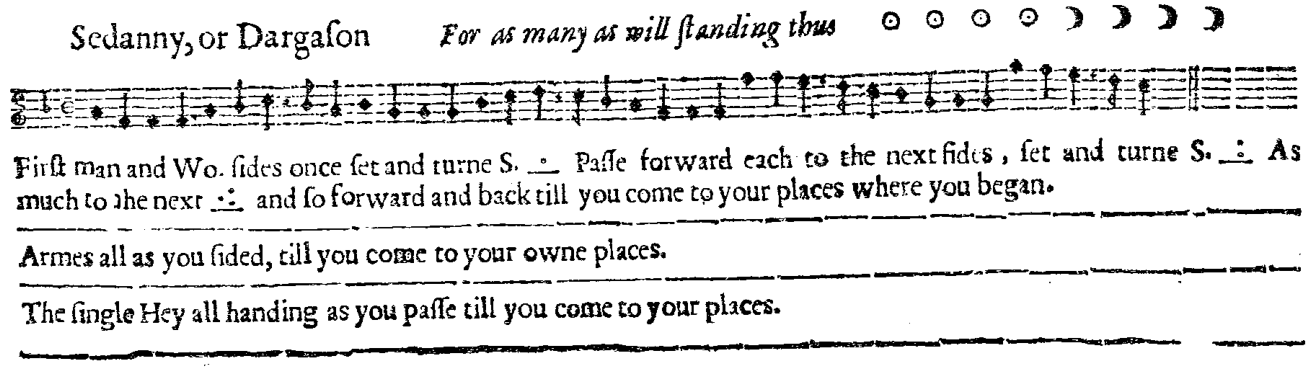
The concept of "couples" doesn't really make sense in this dance – there are two people who start in the middle but no-one else really has any more affinity with any one person more than anyone else. So to dance this I'd just put people in a line and get them to face the centre.
I first learned this the Cecil Sharp way:
- Everything is a right foot lead, using Sharp/"curly" siding – you'd expect this but things do get a bit dizzy, particularly in the second part.
- Looking at it again, for some reason the men turn single right and the women turn single left – I've never danced it like that.
- As soon as first couple reach the end of the line, everyone turns around and starts unwinding the dance again until first couple are in the middle. This means that if you're the poor couple standing at the end, you wait for first couple to get to you, dance twice, then do nothing until they reach you again. I do remember when we danced this at the Round getting a chair to sit on because most of the time in this dance is spent waiting! I don't know why he did this, maybe the limitations of the length of 78rpm records were a factor, but people didn't do dances for as long then.
Let's look again.
Simply starting with a left foot lead, as is normal for dances of this period, unlocks good things:
- Because we are turning single left, we can pass by the normal (right) shoulder easily, which is the same one we sided with.
- It also flows nicely into arming right.
- In part 2, we are alternating between a clockwise movement (arm right) and an anticlockwise movement (turn single left) so we don't get dizzy.
You can go further and alternate right and left – i.e. for the second time through, side left shoulder and set and turn single right. There's some justification for this as if you're following the footwork of the singles and doubles (remembering that everything is in doubles except the sets, which are two singles) then you're on the other foot for the next time through the dance. This is however more confusing for everyone and feels more awkward so I haven't really pursued it.
Once everyone starts dancing, we're going to keep going until everyone is home, much as we would for a progressive grand chain. That means the dance will last longer, and as I keep finding, when you give the original dance a chance, it turns out that this is quite fun. It's certainly more fun than 4th couple standing doing nothing for most of the dance!
It says to wait until everyone is home, which means that the first couple in the middle will be standing for a bit before starting the arming. If you're being purist you should probably do that, but there's no harm in the first couple starting arming as soon as they get home, and everyone else switching to arming when they meet first couple again. You can't do this same trick for part 3 (the grand chain) though because that moves more quickly and you'll catch up with the people who haven't finished yet.
When dancing for fun, I tend to prefer to do this dance in a circle – you can start with everyone dancing, and everyone switches to the next figure at the same time. If it's a big circle then I'll switch to the next part when everyone is halfway round with their partner again; for a smaller circle you can go all the way around the circle until you're back where you started, meeting your partner a second time.
The music itself is only 8 bars long and obviously repeated many, many times – but they're a great 8 bars! Inexperienced musicians might get bored but I've had great musicians who've really run with it, treating it as a theme to use as the basis of improvisation, and as such it can work really well.