A straightforward and lively first edition Playford dance which wouldn't feel out of place on the village green and needs very little interpretation. For added dialect, the index in first edition calls it "Hockley i'th hole".
Could in theory do with almost any number of couples but works best for 4 or 5 couples.
First corners are the people at the left hand end of each line (first man and second woman if gendered), and second corners are at the other end of each line.
| Part 1 | |
|---|---|
| A1, A2 | All lead up a double and back twice. [8] |
| B1, B2 | All set and turn single left and right to your partner. [8] |
| Part 2 | |
| A1 | First corners meet and retire. [4] |
| A2 | Second do the same. [4] |
| B1, B2 | As part 1. [8] |
| Part 3 | |
| A1 | First corners arm right. [4] |
| A2 | Second corners arm right. [4] |
| B1, B2 | As part 1. [8] |
| Part 4 | |
| A1 | Top man / top first corner dance down to the bottom to meet their corner. [4] |
| A2 | Those two lead to the top. [4] |
| B1, B2 | All set and turn single left and right to your partner or whoever you have in front of you – there will be three people together at the top and one on their own at the bottom. [8] |
| Part 5 | |
| A1 | Bottom man / bottom second corner dance up to the top to meet their partner. [4] |
| A2 | Original bottom couple lead to the bottom, followed by original top couple who carry on between them to finish at the bottom of the set. [4] |
| B1, B2 | As part 1. [8] |
Repeat for every other couple.
T:Hockley In The Hole
M:6/8
L:1/8
B:Playford, Dancing Master,1st Ed.,1651.
H:1651.
Z:Chris Partington <www.cpartington.plus>; Chords Andrew Swaine
K:Gmix
"G"dBG dBG|"C"g2e c>de/f/|"G"dBG dBG|1"D"d2B"G"G3:|2"D"d2B"G"G2|
|:G|"G"GAG GB2|"Am"ABA ce2|"G"dBG GAB|1"D"A2G"G"G2:|2"D"A2G"G"G3:|
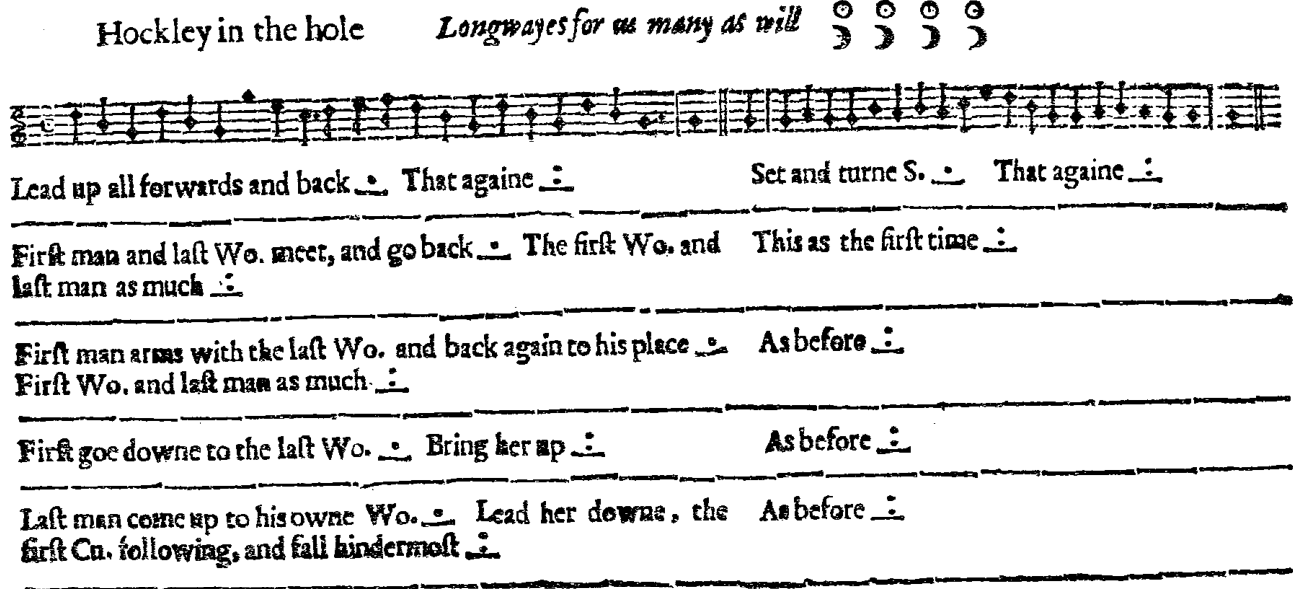
This is all pretty self-explanatory.
As always for pre-restoration dances, I set and turn single left and then right.
In the fourth part, unless your set is really big (which I don't recommend as the middles do nothing but set and turn single), the first man will have a lot of time to get to the bottom. If you use skipped doubles then this breaks it into two doubles of music down and avoids you getting there too early. Likewise use two (skipped) doubles to lead back to the top.
In the set and turn singles following this, first man effectively has two partners and bottom man has none. You could have all the other couples shift by one person at this point but that's really confusing and I think it's far more fun to lean in to the situation: three people set and turn single with each other at the top and one person is left dancing on their own at the bottom. That can even be used to comic effect, sparking indignation before said lonely person comes up to get their partner back in the final part!
Right at the end, it doesn't say how the first couple get past the bottom couple, but going between them is the simplest solution.
It doesn't say to repeat for the other couples, because it never does, but obviously we're going to having so clearly engineered a progression. So repeat for all the other couples. It's best if all the sets in the room can be of the same length for this reason, and 4 or 5 couples is about right. Once every couple has had a go you'll be done – for a 4 couple set that'll equivalent in time to 10 times through a 32-bar dance, or 12½ times 32 bars for a 5-couple set. Even though the actual tune is repeated many times, the time flies by once you get going.