Yes, the tune is Greensleeves – although it's not immediately obvious!
This dance was interpreted by Douglas and Helen Kennedy in 1929 and published in The Playford Ball. It was originally a longways triple minor but has been neatly converted to a 3 couple longways set.
The dance is 64 bars long, so the tune needs playing twice through for once through the dance.
Variant 1: mostly authentic version:
| A1 | 1C set and cast down one place [4]. Repeat to the bottom [4]. |
| A2 | 2C do the same, leaving the set in the order 3 1 2. |
| B1 | 1C full figure of eight with the couple to their right ("1st end couple"): separate and start passing left shoulder with their respective 1st corner, finishing back in middle place. [8] |
| B2 | 1C repeat with the couple to their left ("2nd end couple"), starting passing right shoulder with their 2nd corner. [8] |
| A3 | 1C separate to the right again and hands 3 with their 1st end couple, circling left 1½ to put 1C at the far ends of the set, facing each other up and down the middle, and the other couples improper [6]. 1C pass between 1st end couple up and down and then pass each other right shoulders to take hands in a circle of 3 with their 2nd end couple, standing roughly back to back in the middle of the set [2]. |
| A4 | Circle left 1½ with 2nd end couple, placing 1C at the ends again and the others proper again [6]. 1C pass between 2nd end couple and pass each other to face between 1st end couple [2]. |
| B3 | 1C go between 1st end couple and turn left to start a full hey with this couple (starting as they started the figure of 8), finishing back in middle place proper [8]. |
| B4 | 1C full hey with the 2nd end couple on their left (starting as they started the second figure of eight) [8]. |
Repeat twice more to starting places.
Variant 2: simplified / zesty version
| A1-B2 | As variant 1 [32] |
| A3 | 1C circle left and right with the couple on their right (1st end couple) [8] |
| A4 | 1C circle left and right with the couple on their left (2nd end couple) [8] |
| B3 | 1C full hey with the couple on their right (1st end couple) [8] |
| B4 | 1C full hey with the couple on their left (2nd end couple) [8] |
Repeat twice more to starting places.
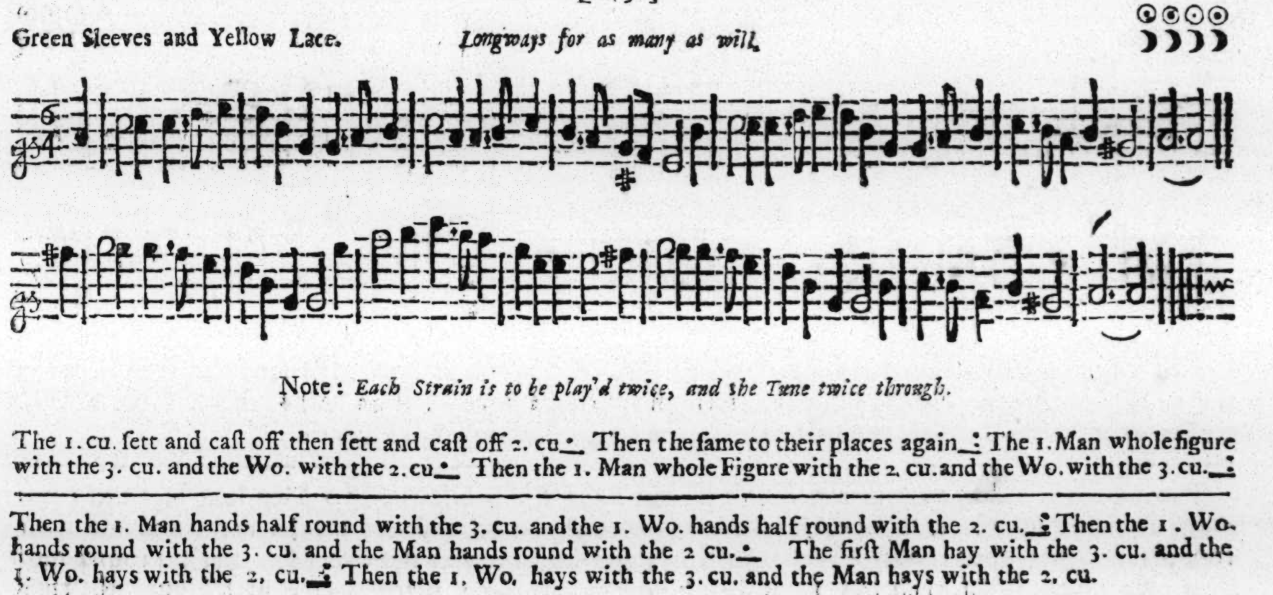
The Kennedys' adaptation for a 3 couple set works nicely, by having 1st couple set and cast twice to the bottom, followed by 2nd couple doing the same, leaving us in the order 312, which:
- puts 1st couple in the middle, where they need to be for the next figure (I'll be honest, I'm not sure how the original was meant to work; Up a Double has a triple minor version which suggests having 2nd couple do a turn single instead of a cast to fix this)
- swaps 2nd and 3rd couples so we don't need a fudge at the end to get a proper progression.
So far so good, and the next figure is straightforward: 1st couple split and do a full figure of eight through the couple on their right, then the couple on their left.
The next figure is the gnarly one. For what it's worth, the wording on Up a Double in the link below doesn't match the wording in the Playford Ball, and they seem different, but both are awkward at different points – although I don't have the original source from the Kennedys to compare. Looking afresh:
- 1st couple separate and take hands 3 with the couple on their right.
- Circle left halfway – this puts them right at the ends of the set, with the end couples now improper.
- Now 1st couple need to take hands with the other couple. They're at opposite ends of the set so can pass up and down through the set just far enough to meet the other couple to do this, which gives symmetry.
- Circle left halfway – this puts the end couples proper again, and 1st couple at the ends again.
- Now first couple can pass up and down through the middle of the set to go through the other end, to start the final figure.
This actually flows pretty nicely. There's far too much time for modern tastes – you can add extra setting in there, or do as the Kennedys did and make the circles once and a half, which works pretty well.
Another option which I've used is to carry on the theme and have the first couple circle left and right with the couple on their right, and then do the same with the other couple. I'm straying into adaption at this point, but it makes for a dance that's easier to call and is satisfying to do, especially for Playford at the more "zesty" end of the spectrum.
The final figure is a pretty unambiguous hey.
I've put both versions above.