This is a lovely and fairly straightforward dance but there are some details elements that require some thought!
| Part 1 | |
|---|---|
| A1,2 | Lead up a double and back twice [8]. |
| B1 | Lines fall back a double [2], then change places with your partner and turn right shoulder to face the other line [2]. Take circles of 3 on each side and slip left once around [4]. |
| B2 | Repeat home. |
| Part 2 | |
| A1,2 | Side right and left [8]. |
| B1 | Lines fall back a double [2], then change places with your partner and face up [2]. 1C cast down into half a hey on each side [4]. |
| B2 | Lines fall back a double [2], then change places with your partner and face down [2]. 1C cast up into half a hey on each side [4]. |
| Part 3 | |
| A1,2 | Arm right and left [8]. |
| B1 | Lines fall back a double [2], then change places with your partner and face up [2]. 1C lead down the middle, the others following, to invert the set [4]. |
| B2 | Lines fall back a double [2], then change places with your partner and face down [2]. 1C cast up the outside, the others following, to invert the set into home places [4]. |
Repeat twice more, each time with first couple casting to the bottom in place of the first lead up a double and back, so that a new couple can lead. Alternatively the first couple can do an extra cast to the bottom at the end of the final figure to join in from the first lead up.
T:Chestnut
T:or Dove's Figary
M:C|
L:1/8
K:F
"Dm"d2a2 g2f2 | "Gm"e3d "A"^c2A2 | "Dm"d2e2 f2f2 | "C"g2fg "F"a4 :| "F"a2ab c'2ba | "C"g2ga b2ag |
"F"a2a2 a2gf | "C"g3f "F"f4 | "Dm"a2ba bagf | "Gm"g2ag agfe | "Dm"f2d2 d2g2 | "Am"e3d "Dm"d4 :|
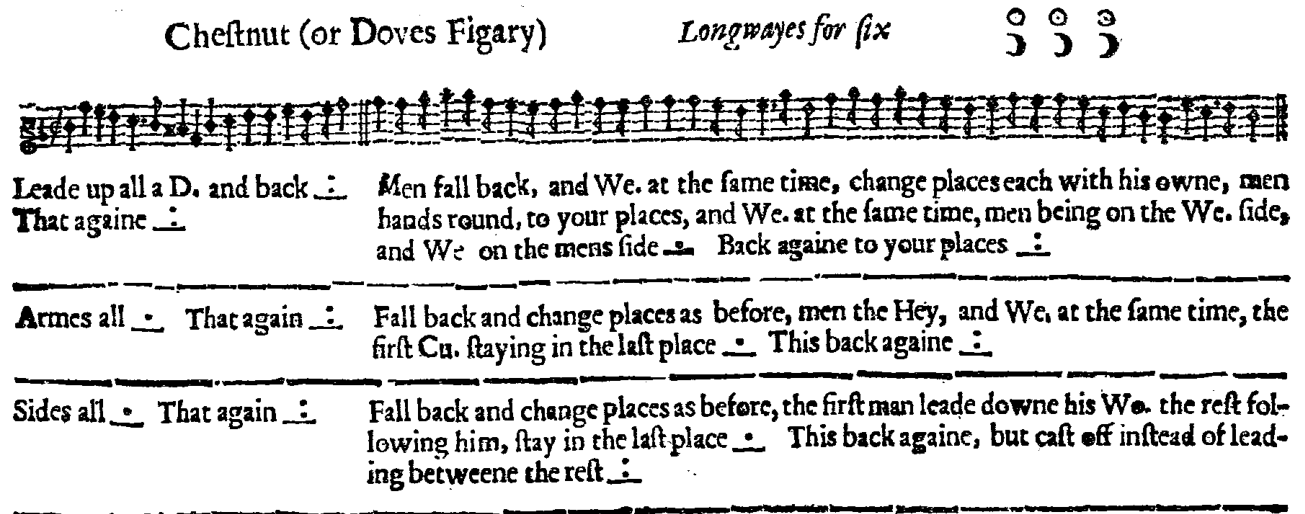
The introductions are the surprising thing to begin with. Uniquely in the Dancing Master (at least in 1st edition, I haven't checked all of them yet), we have arming before siding, rather than the other way around. I can think of few compelling reasons to break such an established formula:
- There's a choreographic reason why doing arming before siding works better for the figures they go with (which can't be resolved satisfactorily simply by switching the order of the figures).
- There's some in joke or story, lost in the midsts of time, why this dance is specifically different.
- They just got the order of the figures wrong in transcription.
I don't see any justification for (1) – there's really not much difference in flow between arriving right shoulder to right with your partner for siding, vs then giving your partner a right arm for arming. If it's (2) then we're not going to get the joke any time soon and unless we do there's no point worrying about it. (3) seems the simplest explanation and easiest for people to remember.
For the first figure really we have two main options:
- After crossing, keep facing out and do half a circle.
- After crossing, turn around and do a whole circle.
If you keep facing out and then do a whole circle then you end up facing in the wrong direction to fall back again. Whichever you do, it really important to call clearly which way you should be facing before taking hands in the circle.
The second figure is quick clearly a half hey on each side (the first Cu. staying in the last place). I like a cast into heys but I'm not overly dogmatic about it; I like to present it as two halves of a whole hey. The third figure is arguably also two halves of a complete lead down and cast back up. Anne Daye makes a compelling case for the first figure also being two halves of a circle, and goes for the circle halfway option, which makes sense if dancing all the figures in doubles; I'm not going to argue with the logic – it's a fine way of doing it and gives the dance a nice symmetry – I simply prefer to dance all the way around, there's plenty of time for it, and I don't think it's out of character with other dances of the era. Feel free to go for the circle halfway option if you prefer it, just make sure to stay facing out before you take hands in the circle, and dance it with clear doubles.
As for whether to circle left both times or circle left and then circle right – a circle left flows better into siding (or arming in the original) than a circle right, and flows better out of turning right shoulders after changing places. So I do left both times.
As with most such dances, I like to do this dance three times, with a different couple at the top each time.